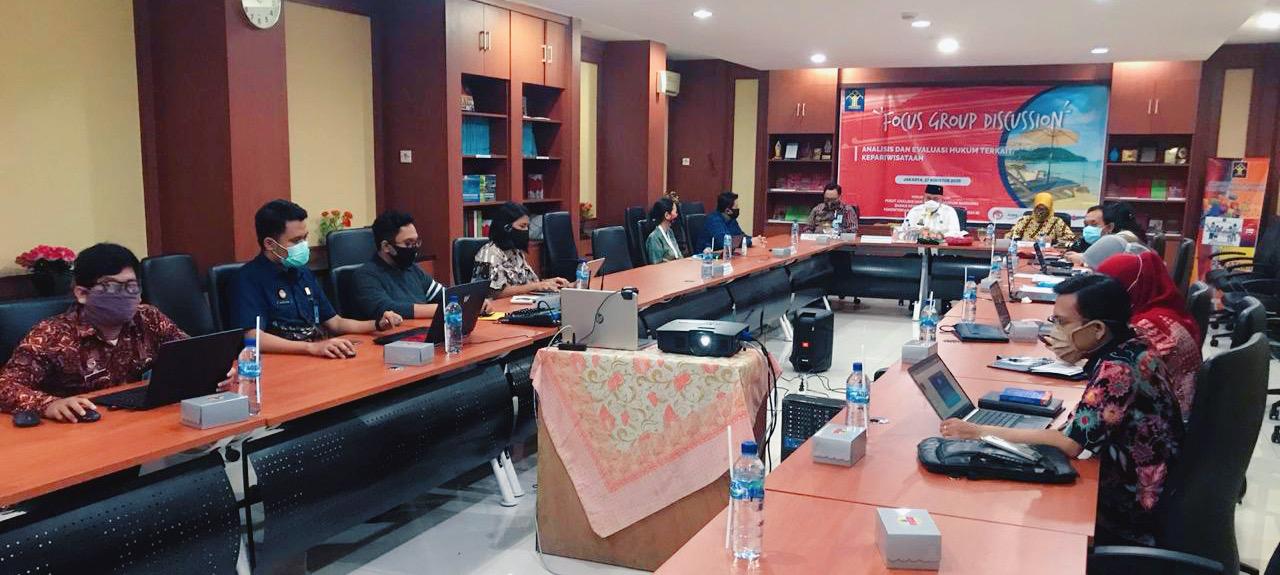
DESMA Center Presentation at the FGD on Analysis and Evaluation of Tourism-related Laws BPHN, Ministry of Law and Human Rights

The National Law Development Agency (BPHN), Ministry of Law and Human Rights held a Focus Group Discussion (FGD) on Analysis and Evaluation of Laws related to Tourism, with the theme, "Simplification of Regulations in the Tourism Sector in Order to Improve the Economy in Indonesia" on Thursday, 27 August 2020 in Jakarta.
The FGD was attended by Prof. Dr. H. R. Benny Riyanto, S.H., M.Hum., C.N., Head of the National Law Development Agency who provided opening remarks on the context and background of the FGD. Also present were Mr Audy Murfi MZ, S.H., M.H; Secretary of the National Law Development Agency, representatives of the Indonesian Hotel and Restaurant Association (PHRI), representatives of the DKI Jakarta Provincial Tourism and Culture Office, and the Jakarta Association of Indonesian Tourism Travel Companies (ASITA). DESMA Center was present as one of the speakers in the FGD.
Prof. R. Benny Riyanto explained that Indonesia is expected to overcome challenges including overlapping regulations. Also overlapping regional authority between various elements of government and their policies. Mainly overlapping laws and regulations related to the tourism sector in Indonesia in terms of tourism business investment.
DESMA Center, represented by Founder and Director Wiwik Mahdayani, stated that socialisation and coordination across sectors and levels of government are needed to harmonise investment policies, especially in the tourism sector. Furthermore, Wiwik Mahdayani from DESMA Center said that the boundaries of authority between the central, provincial and regency/city governments have not been clearly regulated in the Investment Law Number 25 Year 2007.
Furthermore, Wiwik Mahdayani stated that the division of authority in the policy, only focused on the division of investment implementation areas, did not explain the authority of other aspects of investment such as export and import, licensing, marketing, good cooperation relations with domestic and foreign. Thus, it is necessary to clarify the regional policy comprehensively as a reference.
In addition, the DESMA Center mentioned in Law No. 26 Year 2007 Article 26 paragraphs (4), (5) and (6) that there is a review/revision of the RTRW policy document that can be done every 5 years. As a result, many investors enter when the RTRW document is in the revision stage so that they do not have a clear policy basis and regional information to invest during the revision period.
It was also conveyed that legal challenges in the implementation of laws and regulations related to the Tourism sector in Indonesia include (1) Overlap between central and local government regulations; (2) Overlap between regulations in the Act and implementing regulations under the Act; (3) Lack of opportunities for local governments to provide proposals in synergising regional regulatory products with central government regulatory products; (4) mismatch of regulatory products from the central government with regional needs due to the concept of development that tends to be designed top-down.
Legal analysis and evaluation is part of the concept of judicial review (executive review) which has not been well known in constitutional practice compared to the concept of judicial review, or legislative review. Legal analysis and evaluation is aimed at assessing the extent to which: legal norms are in accordance with the idiological values of the State, whether the objectives mandated by law have been achieved, legal effectiveness, and the gap between expectations and reality.
The result of this evaluation analysis is a recommendation on the status of existing laws and regulations, whether they need: (1) improvement (revision); (2) replacement (revocation); or (3) retention. It is in this context that the National Law Development Agency (BPHN) held a Focus Group Discussion (FGD) on the Analysis and Evaluation of Laws related to Tourism.
Photo: Copyright BPHN