Strengthening Tourism TVET Ecosystem in Sumba Barat Daya Programme

Beneficiaries: SMKS Pancasila and SMKN 2 Tambolaka City
Program location: Sumba Barat Daya Regency
Program duration: August 2020-July 2022
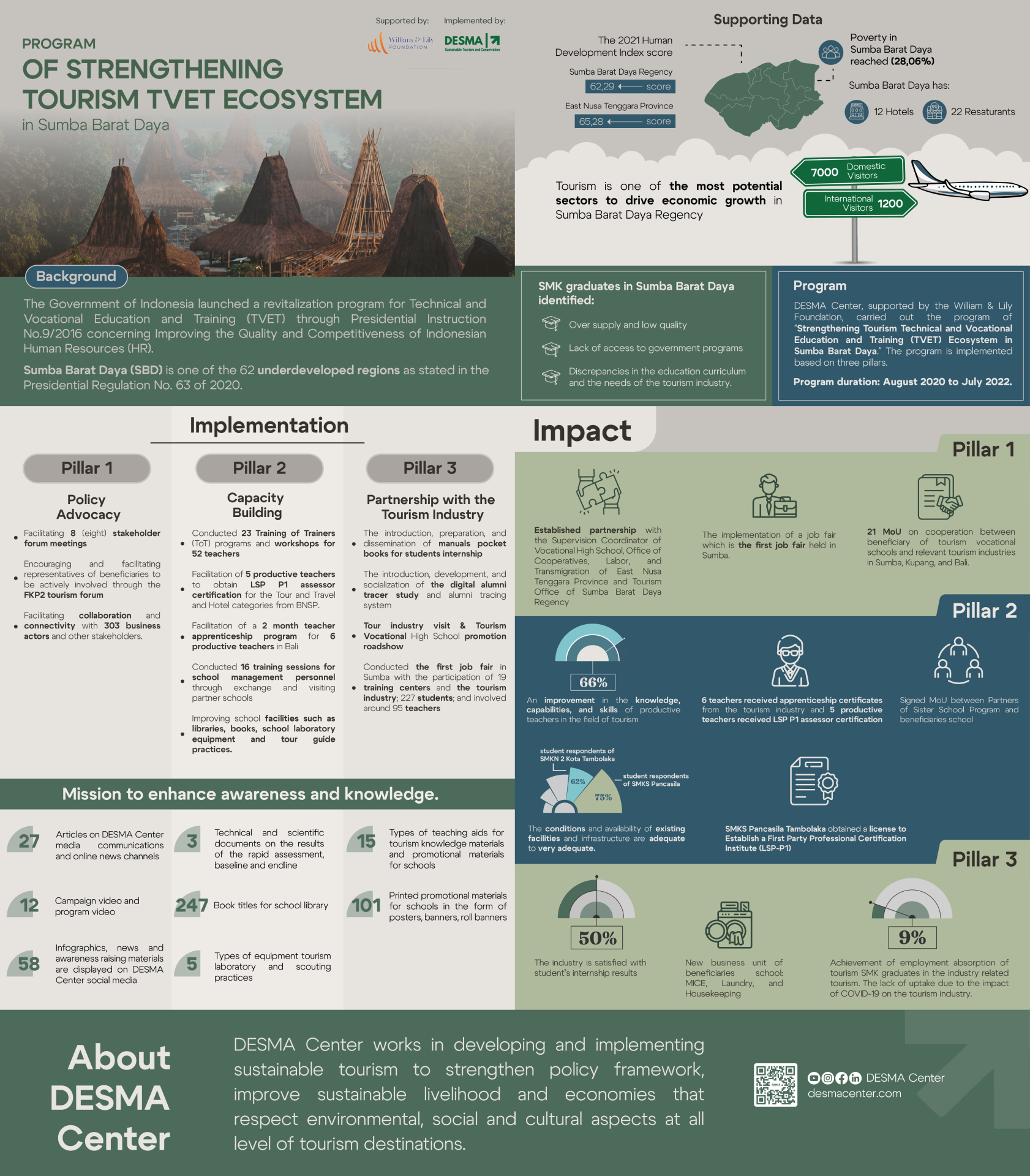
The Government of Indonesia launched a revitalization program for Technical and Vocational Education and Training (TVET) through Presidential Instruction No.9/2016 concerning Improving the Quality and Competitiveness of Indonesian Human Resources (HR).
Sumba Barat Daya Regency (SBD) is one of four regencies on Sumba Island, East Nusa Tenggara Province (NTT), with the capital city of Tambolaka. The 2021 Human Development Index score is 62.29 (East Nusa Tenggara Province score: 65.28); poverty reached 96,300 people (28.06%). SBD is one of the 62 underdeveloped regions as stated in the Presidential Regulation No. 63 of 2020.
Tourism is one of the most potential sectors to drive economic growth in SBD. In 2018, according to the Central Bureau of Statistics, SBD received nearly 7000 domestic visitors and more than 1200 foreign visitors. There are 12 hotels and 22 restaurants in SBD. The head of SBD Regency launched 7 Golden Bridges program to optimize the development opportunities for the tourism sector to boost the economy.
SBD Regency Government recognizes the tourism sector as an opportunity for employment, therefore the government launched programs that aim local human resources could take advantage of these opportunities. However, the expertise and knowledge of local talents have not met the tourism industry standards. The results of a vocational education research carried out by the William & Lily Foundation (WLF) and Landscape in 2019 identified vocational schools (SMK) in SBD is one of the main labour pools, which results oversupply graduates with low quality and low demand of vocational schools (SMK) graduates by the industry. This situation generates an impact on unemployment or on vocational graduates working in irrelevant sectors. These two conditions drive the urgency for providing strategic supports to strengthen local talent's competitiveness in fulfilling the tourism job market in SBD.
DESMA Center, with the programme funded by the William & Lily Foundation, carried out the program "Strengthening Tourism Technical and Vocational Education and Training (TVET) Ecosystem in Sumba Barat Daya." The program was conducted from August 2020 to July 2022.
This intervention aims to engage various stakeholders in driving a positive impact, strengthening tourism vocational formal education and promoting that quality education is the foundation for sustainable tourism development and management.
There are 3 (three) pillars of the programme intervention, which include:
Pillar (1) Policy Advocacy: Focus on improving the capacity of school management to advocate for the TVET agenda in the government development programs. In achieving the objectives of this pillar, DESMA Center carried out activities comprise: facilitating 8 (eight) stakeholder forum meetings; encouraging and facilitating representatives of beneficiaries to be actively involved through the FKP2 tourism forum in SBD. This activity has facilitated and to generate collaboration and connectivity with 303 business actors and other stakeholders.
By the end of the program, the involvement and cooperation with the government that have been implemented includes: (1) the participation of the Supervision Coordinator (Korwas) in every activity carried out; (2) a commitment from the Office of Cooperatives, Labor, and Transmigration of East Nusa Tenggara Province through the Job Training Center and Indonesian Employment Service Companies (PJTKI) to participate in the upcoming Job Fair; (3) active participation of beneficiaries through FKP2 in SBD; (4) active consultation with the Tourism Office of SBD Regency, (5) encourage the commitment of the Tourism Office to provide the budget for the implementation of tourism vocational internship in tourism villages; (7) signing 21 (twenty one) MoU between beneficiary of tourism vocational schools and relevant tourism industries in Sumba, Kupang, and Bali.
Pillar (2) Capacity Building: Focus on strengthening the capacity of tourism vocational schools to prepar for LSP P1 (Professional Certification Body) for the school level. DESMA Center conducted 23 (twenty-three) Training of Trainers (ToT) programs and workshops for 52 (fifty-two) teachers. The ToT and workshops consist of: how to assess industry needs for teachers and school management; housekeeping; front office; food and beverage; the tourism industry; job readiness skills; CV development; and interview preparation.
DESMA Center facilitated five (5) productive teachers in obtaining LSP P1 assessor certification required for the tour and travel and hotel categories, undertaken a two-month apprenticeship program in Bali for six (6) productive teachers, and coordinated a series of sister school activities between beneficiaries with SMKN 1 Kupang and SMKN 3 Denpasar by conducting sixteen (16) training sessions for school management personnel through exchanges and visiting partner schools in SBD and vice versa.
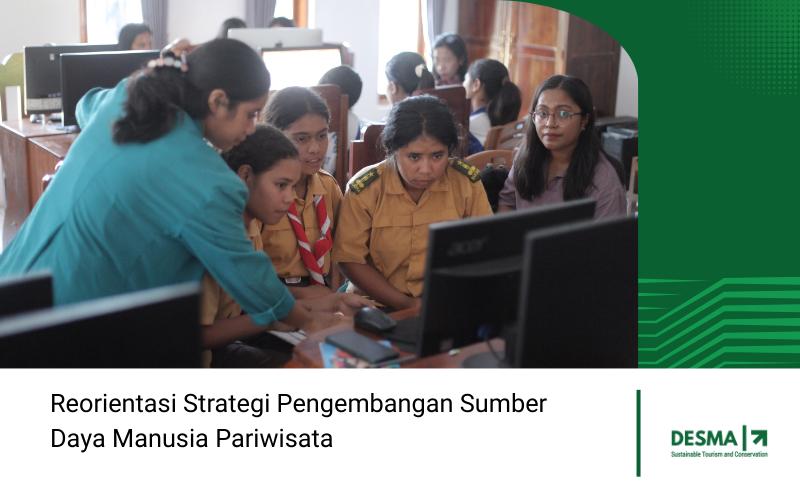
This program also helps to support facilities for practice and/or teaching and learning at schools, providing of classroom teaching and learning materials, equipments and books for the library, as well as teaching support practice tools for practical laboratory. Furthermore, this program also facilitates the printing of brochures, roll banners, and fact sheets for school promotional materials.
The series of activities carried out have resulted the following achievements include: (1) an improvement in the knowledge, capabilities, and skills of productive teachers in the field of tourism, which is very significant with an average total increase of 66%; (2) six teachers received apprenticeship certificates from the tourism industry; (3) five productive teachers received LSP P1 assessor certification; (4) SMK Pancasila received a commitment to the schedule for implementing the assessment of the accreditation to become LSP P1; (5) signed MoU of Sister School program between SMKN 1 Kupang and SMK Pancasila; and (6) signed MoU of Sister School SMKN 3 Denpasar and SMKN 2 Tambolaka; (7) Around 75% of student respondents at SMKS Pancasila and 62% of student respondents at SMKN 2 Tambolaka provide opinion that the conditions and availability of existing facilities and infrastructure are adequate to very adequate.
Until the end of the program, the activities in this pillar has an impact to 1488 students in direct beneficiaries and non-beneficiaries schools.
Pillar (3) Partnership with the Tourism Industry: Focus on improving partnership of tourism vocational schools with the tourism industry. The activities carried out include (1) the introduction, preparation, and dissemination of manuals pocket books for students internship; (2) the introduction, development, and socialization of the digital alumni tracer study and alumni tracing system; (3) assist in developing business plans for business units in schools, as well as facilitating school business unit equipment; (4) facilitating tourism vocational schools visits to the tourism industry, (5) tourism vocational promotion roadshows for junior high school students and socialization of tax reductions for the tourism industry; (6) the implementation of the first ever Job Fair carried out in Sumba, the ceremony was attended by the Head of Regency of SBD with 19 training centres and the tourism industry, 227 students, and involved around 95 teachers participating in the Job Fair.
By the end of implementation, the achievement of programs outcomes include: (1) 50% of the industry satisfied with students internship results; (2) SMKS Pancasila has new business unit such as MICE, and SMKN 2 Tambolaka has new laundry and housekeeping business units. However, (3) the percentage of employment for graduates of tourism vocational schools in the relevant tourism industry only reached around 9% due to Covid-19 that resulted tourism industry closure in Sumba.