Tourism and Climate Change

Auhtor: Firra Kholisha Mustika, Communication Officer
Since the last few years, tourism activities have become a trend for the community. People are willing to set aside money to do tourist activities on weekends either alone, with friends or family. However, for one year we have been faced with restrictions on activities due to the covid19 pandemic.
Tourism activities are one of the sectors that are heavily impacted. Tourism is an activity that involves various industrial sectors. The number of sectors involved makes tourism complex, besides bringing positive impacts, of course there are also negative impacts.
Indonesian Tourism
Indonesia is a tropical country and an archipelago, making it vulnerable to climate change. The trend of climate change in Indonesia is caused by human activities (such as urbanisation, deforestation, industrialisation) and natural events (such as continental drift, volcanic eruptions, changes in the earth's orbit around the sun, sunspot and El-Nino).
Indonesia's natural and cultural wealth has made tourism one of the contributing sectors to the economy. In 2019, foreign exchange realisation from the tourism sector reached Rp280 trillion, an increase from 2018's achievement of Rp270 trillion.
Tourism is a multi-sector industry, which cannot stand alone so it requires collaboration with other sectors. To be said as a tourist destination, there are several things that need to be fulfilled such as attractions, amenities, accessibility and accommodation. The tourist attractions offered come from nature, culture and artificial.
Natural conditions are unpredictable, so the tourism industry is very sensitive to climate change. This is related to the decision of tourists to choose a tourist destination. Factors that influence these decisions include; geography, topography, landscape, vegetation, fauna and climate.
Extreme climate change can have negative impacts, such as longer dry and wet months, rising sea surface temperatures, changing rainfall patterns and intensity, and increasing hydrometeorological disasters, which will have a broad impact on aspects of people's lives and cause significant losses to the economic sector and other development targets, such as food security, health development, infrastructure, and ecosystems.
Tourism is a contributor to climate change
The tourism sector can have a positive impact on the country's economy, but the number of tourists visiting also causes negative impacts. In 2005, it was recorded that the contribution of the tourism sector in contributing to CO2 emissions was 5% and transportation became the largest component in contributing greenhouse gas emissions at 75% (The United Nations World Tourism Organization & International Transport Forum, 2019).
The air travel industry contributes between 2-3% of all global CO2 emissions. Efforts that can be made to reduce greenhouse gas emissions are mitigation and adaptation. With the aim of minimising greenhouse gas effects and adjusting to climate change caused by tourism.
Ecotourism as an effort to minimise the impact of climate change
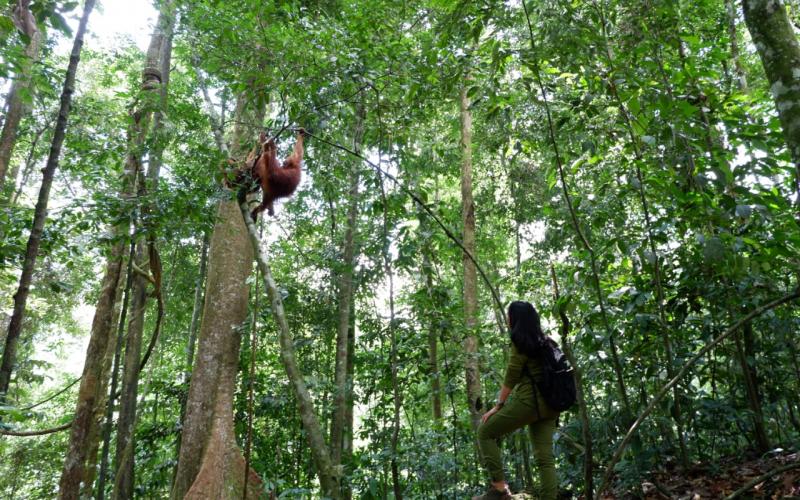
Ecotourism is a tourism activity that is responsible for nature. Prioritising aspects of nature conservation, aspects of socio-cultural empowerment, local community economy and aspects of learning and education.
One form of activity that can be done is by planting mangroves, which functions to minimise the impact of natural disasters, such as tsunamis, storms and waves. An estimated 3.14 billion tons of blue carbon is stored in Indonesia's mangrove forests (Murdiyarso et al in Sidik).
Mangrove planting can also be used for tourism and research activities, then tourism activities will grow the economy of the local community (as tour guides, homestay rentals, restaurants and MSMEs).
Source:
Julismin. 2013. Impacts and Climate Change in Indonesia. Journal of Geography.
Matzarakis, A. 2006. Weather-and climate-related information for tourism. Tourism and Hospitality Planning & Development, 3(2), 99- 115.
Handayani, Mery and Kurniawan, Didi. 2020. Foreign exchange from tourism falls 97 per cent due to the Covid19 pandemic.