Opportunities for Sustainable Development of Amusement Parks and Recreation in Indonesia
Author: Siti Nur Hasbiyana, Programme Associate dan Dani Fauzi, Programme Officer
Reviewer: Wiwik Mahdayani
Desain Grafis: Ganyos Paryama Sidik
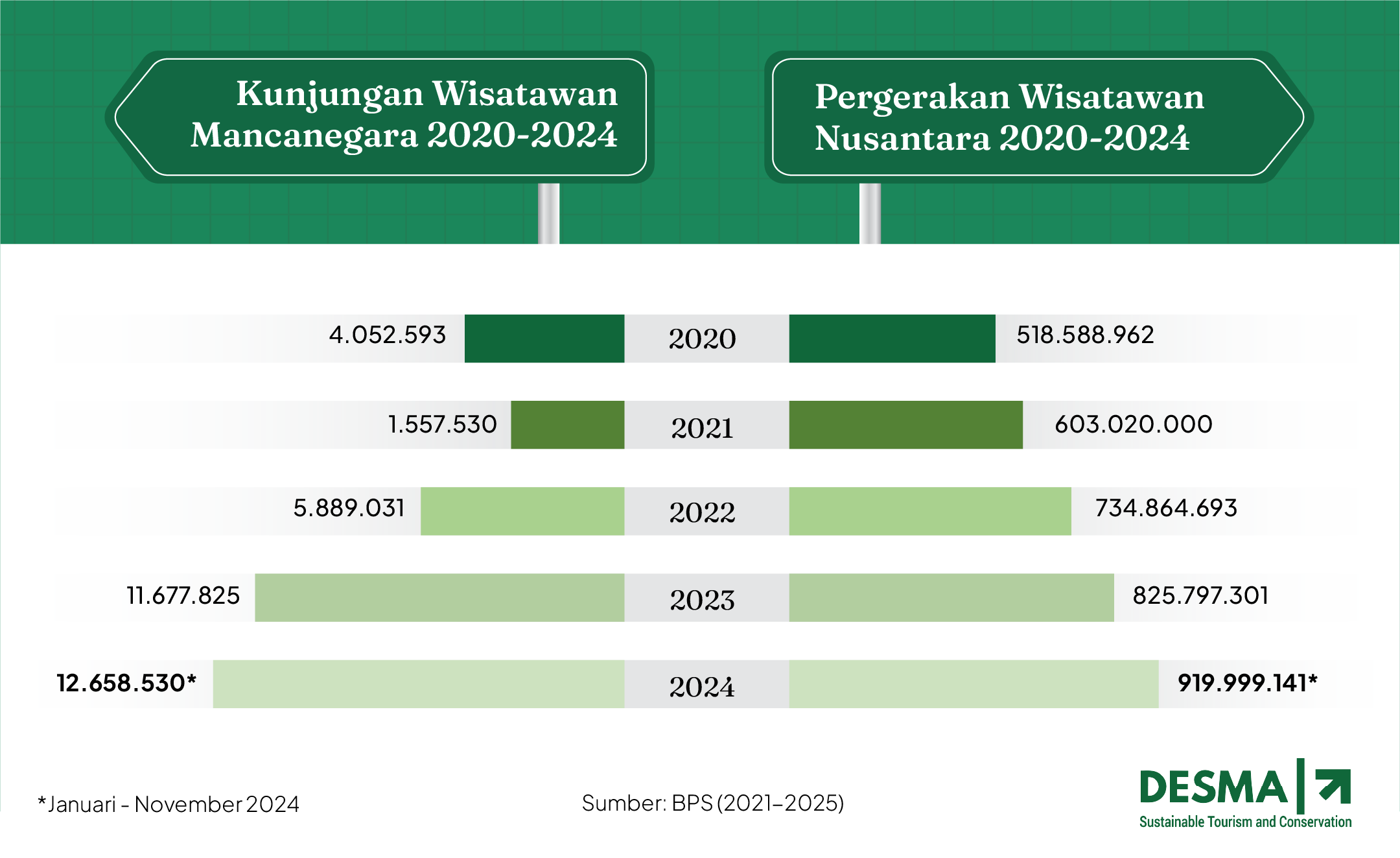
Indonesian tourism is starting to recover after the pandemic. The Central Statistics Agency (BPS) noted that in the January–November 2024 period, foreign tourist visits (tourists) reached 12,658,048 visits or an increase of 20.17 percent compared to the same period in 2023. This figure is the highest in the last 5 years. Meanwhile, the number of movements of domestic tourists (wisnus) in 2024 will reach 919,999,141 trips, or an increase of 22.81 percent compared to 2023. This growth is supported by the efforts of various tourism sectors by improving and improving aspects of human resources, infrastructure, institutions, tourism marketing and other aspects. sustainability. The recovery of Indonesian tourism can be used as momentum for tourism development, one of which is the amusement park and recreation industry.
Amusement and recreation parks are a favorite destination for domestic tourists because they offer a variety of interesting technology-based rides, including playgrounds, zoos and water parks. Apart from refreshing the body and mind, this tourist attraction also provides education for tourists through a sustainable environmental conservation campaign. For local governments, amusement and recreation parks contribute to increasing Regional Original Income (PAD) in the tourism sector and creating jobs (Kemenparekraf, 2024).
Recreational parks are one of the 13 sub-categories of the tourism business sector regulated in Law no. 10 of 2009 concerning Tourism and strengthened through Minister of Tourism and Creative Economy Regulation No. 4 of 2021 concerning Business Activity Standards in Implementing Risk-Based Licensing in the Tourism Sector. Based on data collection and analysis carried out by the DESMA Center team (2024) for the preparation of a study by the Ministry of Tourism and Creative Economy (Kemenparekraf), there are 185 amusement parks in Indonesia that meet the classification according to KBLI 93211 in this regulation.
Of this number, Taman Impian Jaya Ancol recorded the highest number of visits in 2023 with 11,144,860 tourists. This number is very significant, even surpassing the level of visits to Disneyland Paris which only reached 10.4 million tourists in the same period (NDTV, 2024). The latest data, during the 2024/2025 Christmas holiday, Taman Mini Indonesia Indah (TMII) recorded a spike in visits of up to 300 thousand people. This figure increased by 62.16 percent compared to the previous year. This is thanks to the impact of InJourney's massive revitalization since its re-opening in September 2023 (Millennial, 2025).
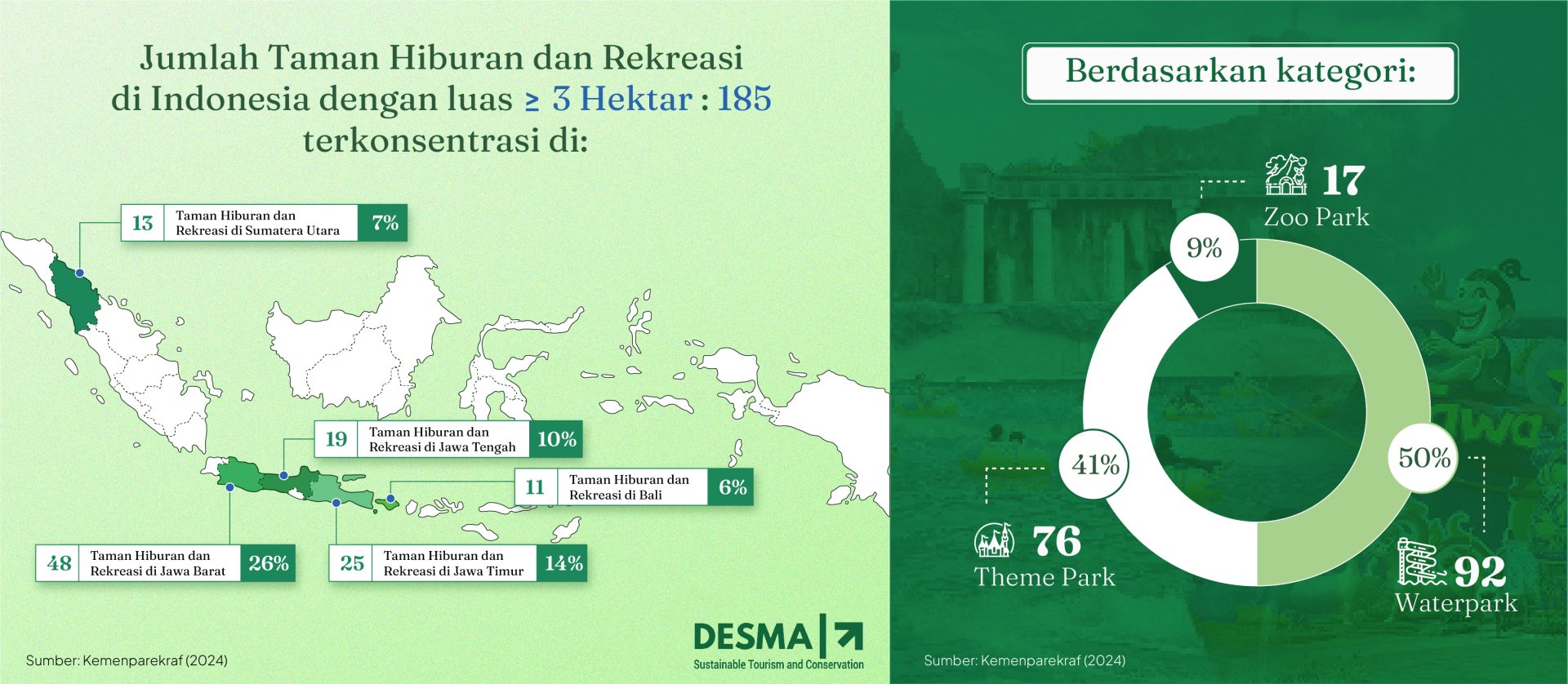
Based on geographic concentration, recreational parks with an area of ≥ 3 hectares (according to the KBLI description in the Minister of Park and Craft Regulation mentioned above) are concentrated in the Java region, especially in West Java (26%), East Java (14%), and Central Java (10%) . This indicates that Java Island, as the center of the economy, population and infrastructure, has a high attraction for the development of amusement and recreation parks. This concentration reflects the spatial phenomenon of tourism, where destination development tends to focus on areas with high accessibility, potential tourism markets, and adequate infrastructure support.
Second, in terms of the amusement park category, the data shows dominance waterpark (50%) compared theme park (41%) and zoo park (9%). This can be attributed to the preferences of the domestic market which tends to choose water recreation-based activities that are relaxing, family friendly, and suitable for Indonesia's tropical climate. Low proportion zoo park shows that there are challenges in promoting conservation-based amusement and recreation parks, both in terms of attraction and infrastructure investment.
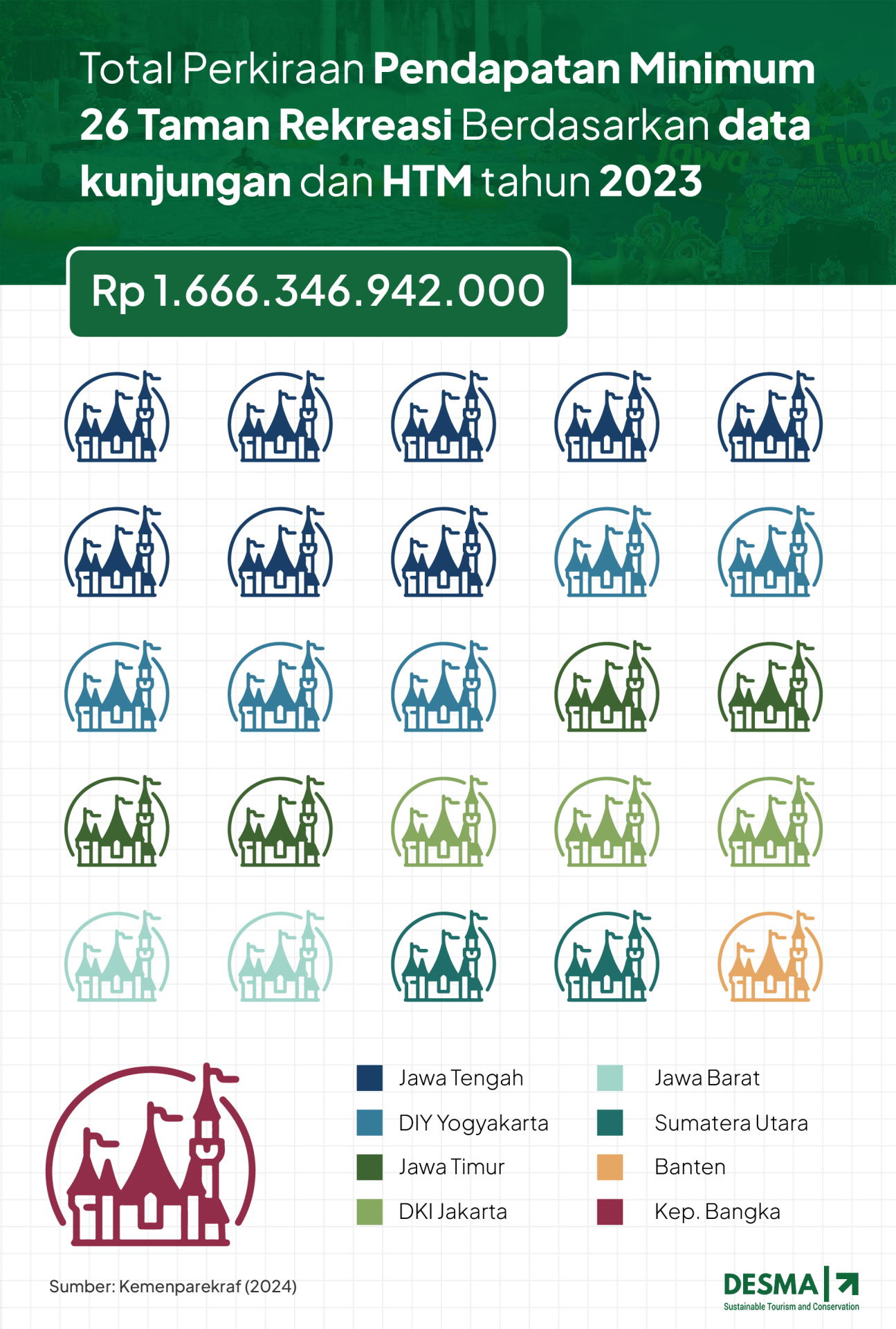
The results of the analysis of 26 recreation parks show that the minimum income for this sector in 2023 is estimated to reach IDR 1.66 trillion. However, optimizing tourist visits still requires improving supporting facilities. Of the 185 amusement parks recorded, 82% do not provide health posts, 77% do not have services lifeguard and 97% do not have a lactation room. This facility is a crucial element in improving tourist comfort, safety and experience while strengthening the attractiveness of recreation parks as superior destinations.
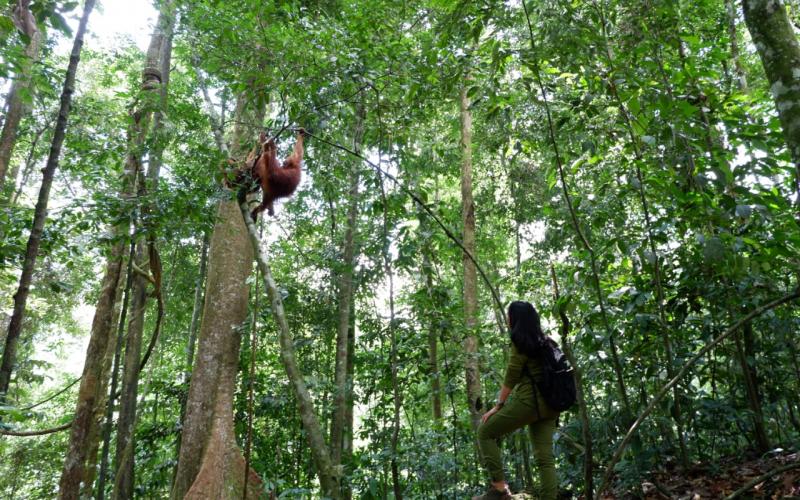
Apart from supporting facilities, the recreational park industry needs to implement sustainable tourism in its development. Consumers are starting to realize how a business can help preserve the environment, socio-culture and economy of the community so that implementing sustainable tourism becomes an added value for consumers.
The amusement and recreation park industry can implement sustainable tourism by implementing waste processing, absorbing local employment and energy efficiency. This aspect of sustainability needs to be demonstrated to tourists by utilizing it digital marketing, so that opportunities for developing amusement and recreation parks can be utilized optimally by paying attention to consumer needs and sustainability principles.
Recreational park development requires synchronization and collaboration between sectors/stakeholders. Synchronization with various sectors is necessary because regulations and permits are complex or do not yet support amusement and recreation park businesses. Collaboration between the private sector and government is also needed to improve Human Resources, promotion and sustainability guidelines. The amusement and recreation parks industry can collaborate with a variety of private sectors to expand promotions, utilize big data to understand consumer behavior and needs, and improve digital-based tourist experiences.
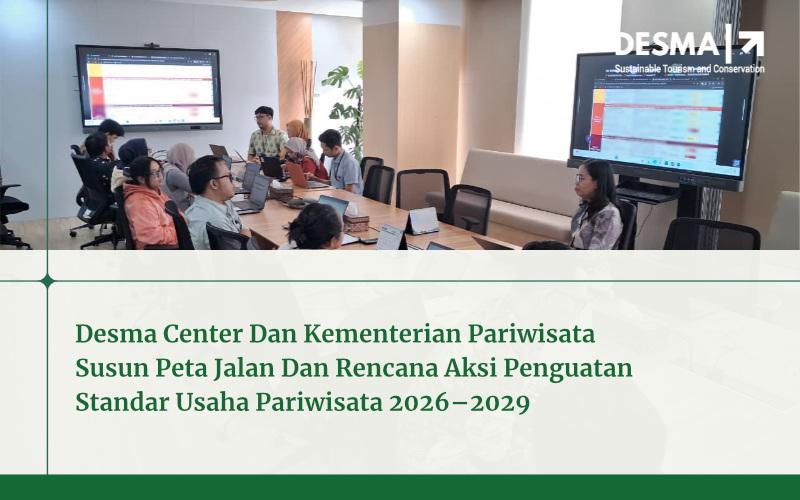
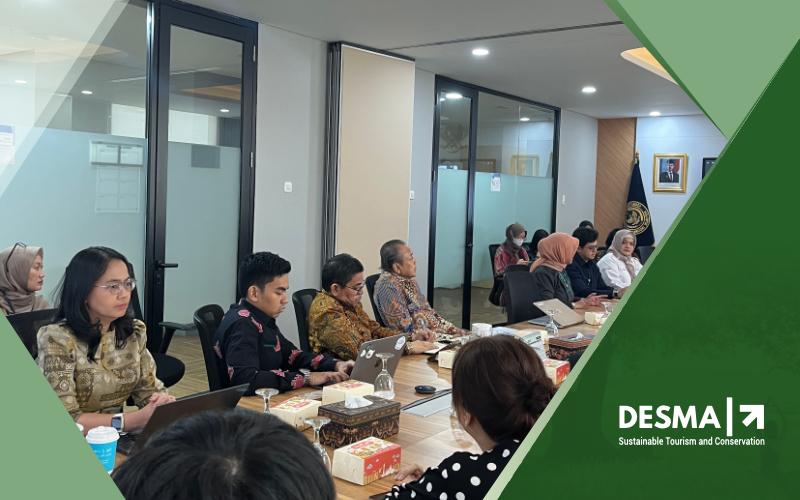
In 2024, DESMA Center collaborated with the Directorate of Industrial Management, Deputy for Industry and Investment, Ministry of Tourism and Creative Economy, to prepare a study on Strengthening the Recreational Park Industrial Ecosystem in Indonesia and Profiling Recreation Parks in Indonesia. This study and profiling resulted in a comprehensive strategy that includes aspects of policy, sustainability, industrial strengthening, as well as mapping the distribution of recreational parks, identifying challenges and opportunities, and analyzing development potential. The main objective of this strategy is to encourage the creation of better quality, competitive and sustainable management of the recreation park industry to support the growth of the national tourism sector.
Reference:
Central Statistics Agency (BPS). (2021). 2020 Indonesian Tourist Statistics. Jakarta: BPS.
Central Statistics Agency (BPS). (2022). 2021 Indonesian Tourist Statistics. Jakarta: BPS.
Central Statistics Agency (BPS). (2023). Indonesian Tourist Statistics 2022. Jakarta: BPS.
Central Statistics Agency (BPS). (2024). Indonesian Tourist Statistics 2023. Jakarta: BPS.
Indonesian Ministry of Tourism and Creative Economy. (2024). Strengthening the Recreational Park Industrial Ecosystem in Indonesia. Jakarta: Indonesian Ministry of Tourism and Creative Economy.
Millennium, M. F. (2025, January 7). TMII, the Nataru Holiday Tourist Attraction in Jakarta that is Popular. Retrieved from GNFI: https://www.goodnewsfromindonesia.id/2025/01/07/tmii-tempat-wisata-libur-nataru-di-jakarta-yang-jadi-primadona
NDTV. (2024, September 15). World's Top 10 Most-Visited Theme Parks. Retrieved from NDTV World: https://www.ndtv.com/world-news/worlds-top-10-most-visited-theme-parks-6569203